The Questions Objects Ask
A battery charged by corpses, a clock that eats flies, a Britain split into four. A look at the landmark works of speculative design, and how design becomes a question.
So far, I’ve looked at the concepts and tools of speculative design. In this piece, I’ll look at four landmark works and see how design asks questions, through objects that are unsettling and strange in their own way.
If Energy Remained After Death: Afterlife
James Auger and Jimmy Loizeau’s Afterlife proposes a design that uses microbial fuel cells to convert the chemical energy left in a dead body into electricity, stored in a battery. The battery is engraved with the name of the deceased and used to power electronic devices. Against the common notion that death severs everything, it poses an idea, and a question: what if the dead could instead supply energy vital to our lives?
It may feel a little unpleasant at first, but seen from a slightly different angle, it may not be so different from scattering ashes or turning them into a diamond. What is the difference between a part of the deceased having a use, and being used up and gone? It makes you think about how our ideas of death might shift, and what kind of future the changing social notions brought on by technological progress might bring about.
Predators in the House: Carnivorous Domestic Entertainment Robots
Another work by the same pair proposes furniture-like robots that catch pests in the home, such as insects and mice, and use their bodies as an energy source. There is a clock wrapped in flypaper, a coffee-table robot with a mousetrap, and a lampshade robot with a pouch-like organ modeled on carnivorous plants such as the pitcher plant.
What if a machine that generates the energy it needs to run did so by catching the insects and mice we regard as pests, and performed a function useful to us in the process? How would we come to perceive it, and how would our thinking about life work then? Beyond breaking the stereotype of what a robot is as a product, this work raises many more questions about technological progress and human-centered thinking.
Humans Who Change How They Eat: Foragers
Dunne & Raby’s Designs for an Overpopulated Planet: Foragers presupposes a world short of food. People in this food-scarce future borrow the power of synthetic biology to build digestive devices modeled on those of herbivores, and forage and digest plants that human digestion could never handle before.
What’s interesting is the direction in which the problem is solved. The familiar answers to a food crisis mostly point toward increasing production, but this work imagines instead that people will change their own bodies and tools. It’s amusing, but also chilling: less a fundamental solution than an instinctive, greedy way of solving a problem. It asks what kind of future we are letting happen, and works as a kind of warning.
Four Britains: United Micro Kingdoms
Commissioned by the Design Museum in London and exhibited in 2013, this work sets up a world where Britain has split into four super-shires, each with its own ideology and technology, and imagines the way of life in each society. In the east are the Digitarians, whose every aspect of life is managed by algorithms; in the west, the Bioliberals, who prize biotechnology and nature; in the north, the Anarcho-evolutionists, who dream of evolution by modifying their own bodies; and in the center, the Communo-nuclearists, who have built a community on near-limitless nuclear energy.
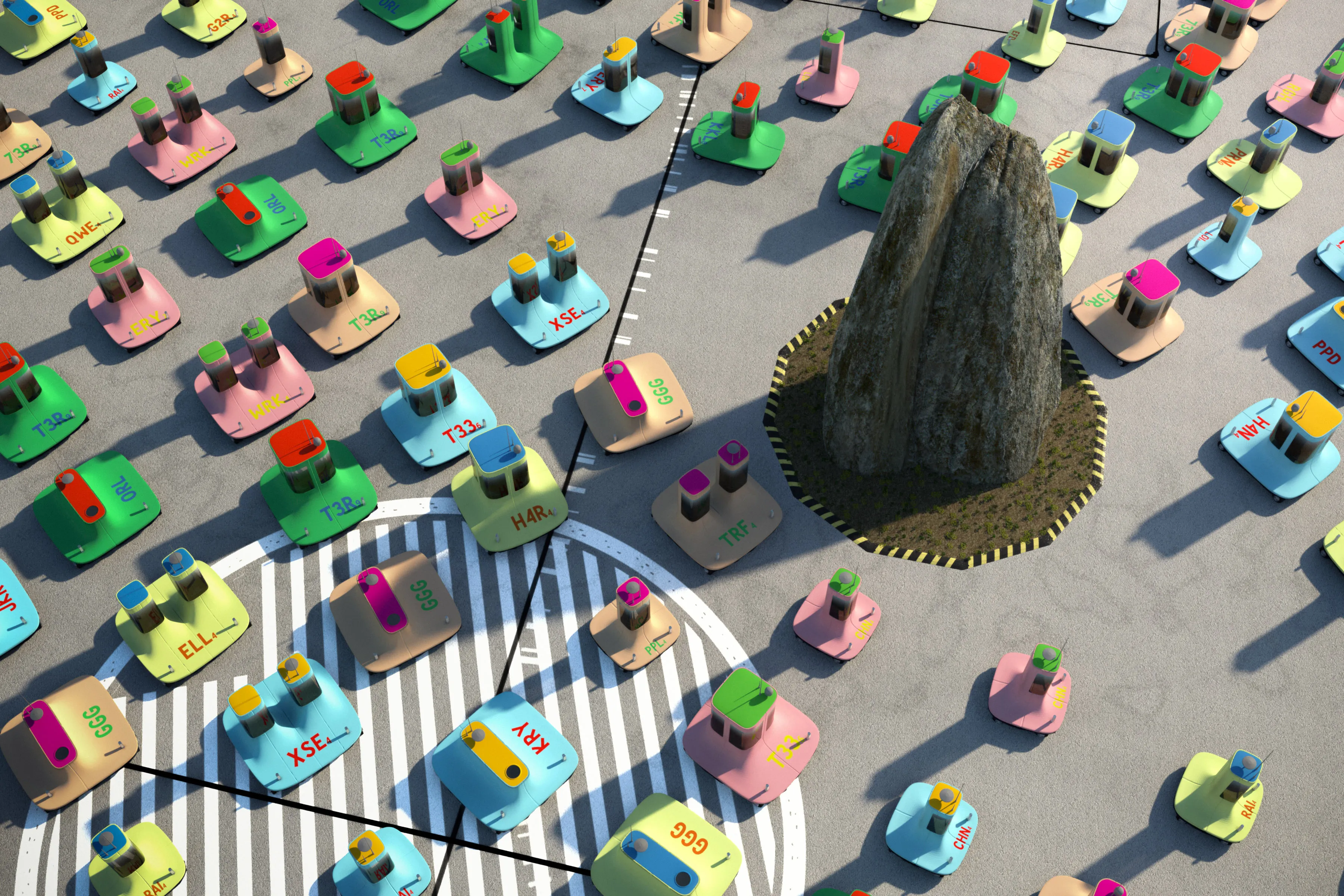
Digitarian digicars from United Micro Kingdoms, Dunne & Raby (2013)
Each world in this work sits at a technological extreme, but because each pursues a different direction, the strengths and weaknesses show up starkly. The Digitarians show a fully transparent and controlled society built on technology-driven data tracking, while the Bioliberals show a slow, ecology-centered society living in symbiosis with nature. The Anarcho-evolutionists focus on enhancing their own bodies, trying to overcome everything through physical ability, with a somewhat individualistic bent, and the Communo-nuclearists show a communist-leaning society of convenience that enjoys limitless energy and has stopped developing.
Four directions of technology grown from a single nation, and the glimpses of the societies built on them, suggest a great deal. Technological progress is not one-directional. Depending on the values and systems pursued, technology at a similar level can produce completely different pictures of society. Progress matters, but what steers it is ultimately the direction of our thinking.
How Discomfort Does Its Work
Set the four works side by side and something they share comes into view. They speak through concrete objects, they offer no answers, and they don’t try to persuade. The viewer simply encounters the object as a fragment of reality, lingers for a while in that fiction, and comes back. And that is when thinking begins.
As I said earlier, when we take a way of life too much for granted, we can’t even see it. Discomfort is one tool for cracking that taken-for-grantedness. By delivering a shock to what seemed obvious and making us look back at our present and future, it works so that we can revise the present and change the future once more.
Still, a doubt remains. Does thinking deeply in a gallery actually change the world? In the next piece, I’ll cover a major case that stepped out toward the world more directly, and changed it.
References
- Auger-Loizeau, Afterlife
- Auger-Loizeau, Carnivorous Domestic Entertainment Robots
- Core77, Between Reality and Impossible: Dunne and Raby at St Etienne Biennale