Factual and Value Judgments About the Future
The futures cone, a staple of explanations of speculative design, began as a tool of futures studies. Following the history of the diagram, this piece looks at how the "preferred future" differs from the other categories.
In the first piece of this series, I introduced the futures cone. It’s a diagram that sorts the futures extending from the present into probable, plausible, and possible ones, and proposes moving toward the preferred one among them. It also appears in nearly every explanation of speculative design.
This diagram wasn’t made by designers. It’s a tool first used in futures studies, and looking into its history lets me restate, a little more accurately, what I passed over briefly in the first piece.
The Futures Cone and Its History
According to the history compiled by the Australian futurist Joseph Voros, Norman Henchey in 1978 divided futures into four kinds: possible, plausible, probable, and preferred. In 1990, Charles Taylor added a “cone of plausibility” whose range widens along a time axis. A picture close to the form we know emerged in 1994, when Trevor Hancock and Clement Bezold moved Henchey’s classification onto the cone. Voros began using it in his own foresight work around 2000 and went on to add more categories. So the cone we know took shape through many hands.
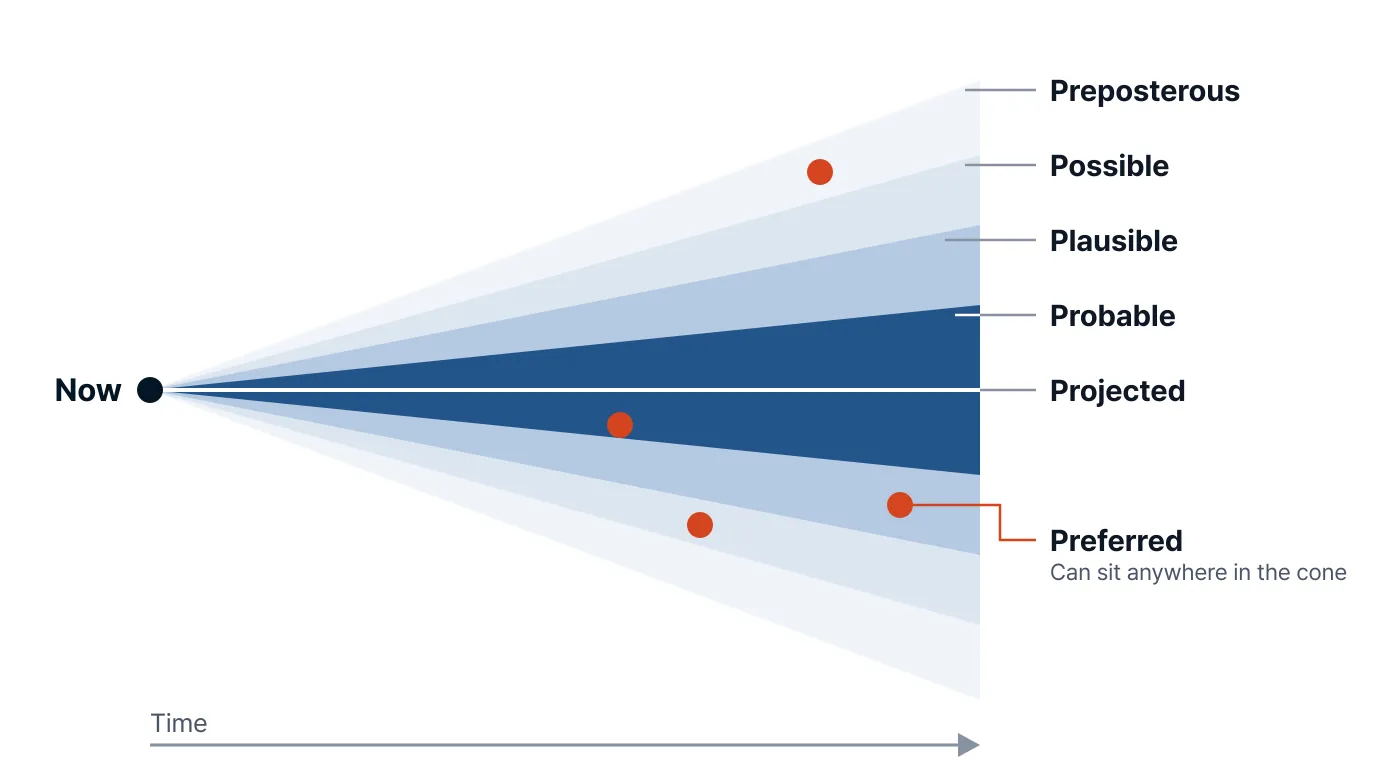
The futures cone, redrawn after Hancock & Bezold (1994) and Joseph Voros
How Likely Is It
Looking more closely at the picture with this in mind, it becomes clear what this diagram really is.
- Projected: A future that simply extends the flow so far, predicted as is from the present moment: the so-called default future.
- Probable: A future that is “likely” to happen even without change. It usually rests on current trends.
- Plausible: A future that “could” happen, in light of how we currently understand the world.
- Possible: A future that “might” happen, depending on knowledge we don’t yet have.
- Preposterous: A future considered impossible for now.
The further in you go, the more certain a future is given current trends; the further out, the less likely it seems. In the end, these five categories sort futures by how plausible they seem.
One caution: this judgment, too, is made by us, now. It isn’t rare for the preposterous future of one era to become the everyday life of the next. So the cone’s boundaries are less an objective partition of the world than a drawing of where our imagination currently stands.
Preference Lies on a Different Axis
Now for the “preferred future.” Here lies the most important point of the diagram. Voros says that while the categories above are largely cognitive judgments about what is likely to happen, the “preferred future” is a value judgment about what ought to happen.
That’s why the preferred future isn’t fixed to a particular zone of the cone. For one person, the default future may be the best; for another, a future that looks preposterous today may be the most desirable. Just as people’s values vary, preference can appear anywhere across the cone. On the other side are futures that shouldn’t happen.
When introducing the concept in the first piece of this series, I explained that conceptual design puts its emphasis on what is likely to appear in reality, while speculative design leads toward the preferred future. That explanation alone can make the distinction confusing, but set against the two axes covered here, the difference becomes clear: one sits on the axis of probability and the other on the axis of value. They can seem alike in showing the future through the present, but they clearly have different purposes and concerns.
What Changes as a Result
This distinction may look like wordplay, but it makes a practical difference. In meetings about the future, “this will probably happen” and “this is how it should be” blur together easily.
“All customer support will be handled by AI” sounds like a forecast. But it often carries, slipped in alongside, a judgment that this would be a good thing. Borrow the form of a forecast, and a value judgment passes without debate. Something already decided isn’t a matter to be for or against; it simply becomes a premise of design, its environment.
The futures cone lets us separate two questions. How likely is it? And, separately, should it happen? There are futures worth pursuing even if they’re unlikely, and futures worth stopping even if they’re likely. Speculative design often visits the outer edge of the cone not out of a taste for the absurd, but, we could say, to break the illusion that the default is the only future.
So how can we bring a future that hasn’t arrived in front of people in a way that feels real? In the next piece, I’ll look at design fiction, a method often used for this.
References
- Joseph Voros, The Futures Cone, use and history (2017)
- Trevor Hancock, Clement Bezold, “Possible futures, preferable futures”, Healthcare Forum Journal (1994)